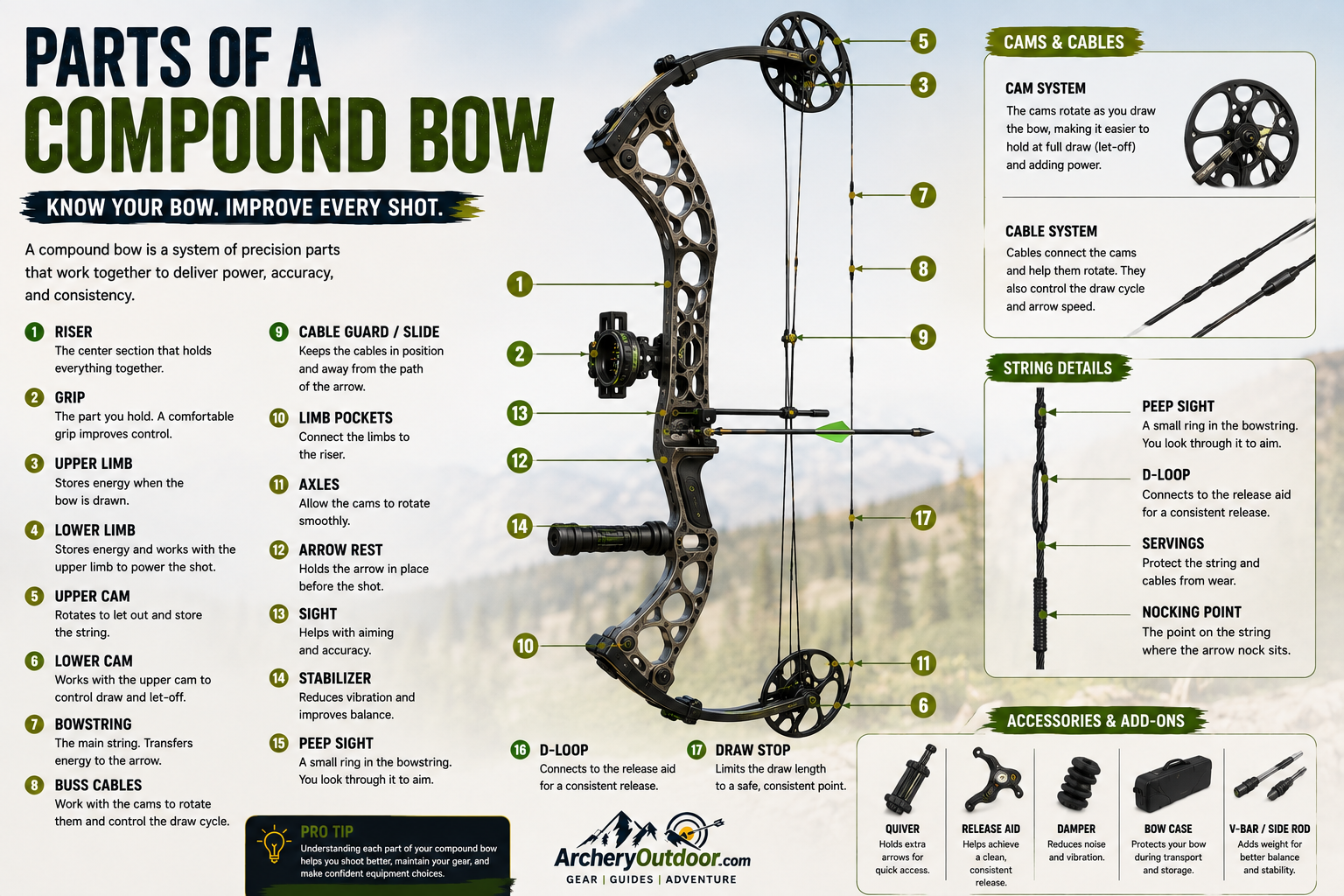

A compound bow contains several precisely designed components that work together to store and transfer energy efficiently. Therefore, learning the parts of a compound bow is one of the best ways for beginners to understand modern archery equipment.
At first, compound bow anatomy can seem complicated. However, once you identify the riser, limbs, cams, cables, string, arrow rest, and other components, the design becomes much easier to understand.
Unlike a traditional recurve bow, a compound bow uses a cam-and-cable system to change the mechanical advantage during the draw cycle. As a result, many compound bows provide features such as let-off, adjustable draw lengths, and highly customizable setups.
Whether you are a new archer, an outdoor enthusiast, or someone researching a compound bow purchase, this guide explains the parts of a compound bow in simple terms. Additionally, you'll learn how the components work together, which accessories matter, and what you should inspect regularly.
Understanding Compound Bow Anatomy
Before looking at individual parts of a compound bow, it helps to understand the overall design.
The main structure consists of a riser, two limbs, cams, a bowstring, and cables. Together, these components create the mechanical system that makes a compound bow different from a traditional bow.
When you draw the bow, the string moves backward. At the same time, the cams rotate and the limbs flex. Consequently, the bow stores energy while the mechanical advantage changes throughout the draw cycle.
Near full draw, many compound bows reach a point where the holding force becomes significantly lower than the peak draw force. This characteristic is called let-off.
Furthermore, archers can customize their bows with sights, arrow rests, stabilizers, peep sights, quivers, and release aids.
Therefore, understanding the parts of a compound bow also helps you understand why different setups can feel and perform differently.
Main Parts of a Compound Bow
The main parts of a compound bow include:
- Riser
- Grip
- Upper limb
- Lower limb
- Upper cam
- Lower cam
- Bowstring
- Buss cables
- Cable guard or cable slide
- Limb pockets
- Axles
- Arrow rest
- Sight
- Stabilizer
- Peep sight
- D-loop
- Draw stop
- String serving
- Cable serving
- Quiver
Not every compound bow has exactly the same configuration. Therefore, manufacturers may use different designs, while accessories can also vary depending on the type of archery you practice.
Each component performs a specific function. Moreover, these parts must work together correctly for the bow to operate as designed.
Riser
The riser forms the central body of the compound bow.
It connects the upper and lower sections of the bow. Additionally, it provides mounting points for many accessories, including the sight, arrow rest, stabilizer, and quiver.
Modern compound-bow risers commonly use aluminum or other engineered materials. As a result, manufacturers can create strong structures while managing weight and balance.
The riser can influence how a bow feels in the hand. Therefore, its design matters when comparing different compound bows.
Grip
The grip is the section where the archer places the bow hand.
Grip designs vary from one manufacturer to another. Some are narrow and minimalist, while others provide more pronounced contours.
However, comfort is not the only consideration. A consistent hand position also matters because repeatable technique can contribute to more consistent shooting.
For that reason, beginners should learn proper grip technique rather than simply squeezing the bow as tightly as possible.
Limbs and Limb System
The limbs are among the most important parts of a compound bow because they store energy during the draw cycle.
Upper Limb
The upper limb extends from the upper portion of the riser toward the upper cam.
When you draw the bow, the limb flexes. Meanwhile, the cam rotates and the cable system changes position.
As a result, the limb stores energy that later contributes to moving the string and arrow.
Because limbs experience substantial forces, inspect them regularly for visible damage.
Lower Limb
The lower limb performs a similar function at the bottom of the bow.
It connects the lower portion of the riser with the lower cam assembly. Furthermore, it works together with the upper limb, cams, cables, and string.
The exact design varies between manufacturers. Therefore, always follow the manufacturer's instructions for inspection and maintenance.
Limb Pockets
Limb pockets connect the limbs to the riser.
They help position and secure the limbs within the bow's structure. Although limb pockets may not attract as much attention as the cams, they remain important structural components.
Consequently, any obvious damage around this area deserves professional attention.
Understanding Compound Bow Cams
The cams are some of the most distinctive parts of a compound bow.
Unlike a recurve bow, a compound bow uses rotating cams to change the mechanical characteristics of the draw cycle.
Upper Cam
The upper cam sits near the upper limb tip.
As you draw the bow, the cam rotates. This movement changes the relationship between the string, cables, and limbs.
Therefore, the cam design influences several characteristics, including:
- Draw length
- Draw-force curve
- Let-off
- Holding weight
- Overall shooting feel
Different cam systems can produce noticeably different draw cycles. Consequently, two bows with similar draw weights can still feel very different.
Lower Cam
The lower cam sits near the lower limb tip.
It works together with the upper cam and cable system throughout the draw cycle. Furthermore, the two cams need to remain properly synchronized according to the bow's design.
Because of this, complicated cam adjustments should not be treated as casual modifications.
If you are unsure about cam settings, consult the manufacturer's instructions or a qualified bow technician.
Axles
Axles provide the pivot points around which the cams rotate.
Although they are relatively small, they play an essential role in the cam system.
Therefore, unusual cam movement, visible damage, or other mechanical problems should receive professional attention.
Bowstring and Cable System
The bowstring and cables form another essential group of parts of a compound bow.
Together, they control the movement of the cams and transfer energy through the bow during the shot cycle.
Bowstring
The bowstring is the primary string that interacts with the archer and arrow.
During the draw, the archer pulls the string backward. At the same time, the cams rotate and the limbs flex.
When the string is released, the stored energy moves the string forward and contributes to accelerating the arrow.
The string can also contain several smaller components, including:
- Center serving
- Peep sight
- D-loop
- Nocking references
Because the bowstring experiences repeated stress, regular inspection is important.
For example, watch for excessive fraying, broken strands, damaged serving, or unusual wear.
Buss Cables
Buss cables work with the cams and limbs to control the bow's mechanical system.
Their exact configuration depends on the bow model. Therefore, cable layouts can look different from one compound bow to another.
Additionally, cables can experience wear over time. For this reason, inspect them periodically and seek professional help if you notice unusual damage.
Cable Guard and Cable Slide
Many compound bows use a cable-management system.
A cable guard and cable slide can help control the position of the cables as the bow moves through the draw cycle.
However, modern bows may use alternative cable-management systems.
Regardless of the design, the goal remains similar: maintain appropriate cable positioning while allowing the bow to operate correctly.
String Serving
Serving consists of additional thread wrapped around specific portions of the bowstring.
It protects areas that experience repeated contact and wear.
For example, the center serving sits around the section where the arrow and release system interact with the string.
Over time, serving can wear. Therefore, inspect it regularly and address significant damage before shooting.
Cable Serving
Cables can also include served sections.
These sections help protect the cable from wear at specific contact points.
Similarly, cable serving should form part of your regular equipment inspection.
Arrow Rest
The arrow rest supports the arrow before and during the beginning of the shot.
Several arrow-rest designs are available for compound bows, including:
- Drop-away rests
- Launcher-style rests
- Containment rests
Each design has different characteristics. Therefore, the best choice depends on your bow, arrows, shooting discipline, and personal preferences.
Why Does the Arrow Rest Matter?
The arrow needs to sit in a consistent position before the shot.
Additionally, the rest needs to allow the arrow to leave the bow appropriately.
As a result, an incorrectly installed or poorly adjusted arrow rest can affect consistency and arrow flight.
For beginners, professional setup can be particularly useful because proper alignment and tuning can be difficult to judge without experience.
Bow Sight
A bow sight provides an aiming reference.
Compound-bow sights range from simple recreational designs to highly adjustable target models.
A sight can include:
- Sight housing
- Pins
- Mounting bracket
- Adjustment mechanism
- Bubble level
How Does a Sight Help?
A sight gives the archer a repeatable aiming reference.
However, an expensive sight cannot replace good shooting fundamentals. Instead, proper stance, anchor position, grip, release, and consistent practice remain essential.
Therefore, beginners often benefit from choosing a simple, reliable sight before investing in more complicated systems.
Peep Sight
A peep sight is a small device installed in the bowstring.
When the bow reaches full draw, the archer looks through the peep while aligning it with the main sight.
As a result, the peep can provide another consistent reference for aiming.
Why Is Peep Alignment Important?
The peep needs to work properly with your draw length, anchor position, and sight setup.
If the peep rotates significantly or appears incorrectly positioned, have the bow checked by a qualified technician.
Furthermore, avoid making complicated string adjustments without the correct equipment and knowledge.
Stabilizer
A stabilizer attaches to the front of the riser.
Its primary purpose is to influence balance and handling. Additionally, some stabilizer systems can affect the bow's movement and vibration characteristics.
Some archers use a simple front stabilizer. Meanwhile, target setups may use longer systems with side rods and additional balancing components.
Do Beginners Need a Stabilizer?
Not necessarily.
A simple setup can be easier to handle when you're learning. As your experience develops, you can determine whether additional stabilization fits your shooting style.
Most importantly, don't assume that adding more equipment will automatically improve accuracy.
D-Loop
A D-loop is a small loop of cord attached to the bowstring.
Many compound-bow archers use a mechanical release aid that attaches to the D-loop.
The loop provides a consistent attachment point. Additionally, it can help protect the main bowstring from repeated direct contact with the release mechanism.
When Should You Inspect a D-Loop?
Inspect the D-loop periodically for significant wear, fraying, or damage.
Because it experiences repeated stress, replace it when necessary rather than continuing to use visibly compromised material.
Draw Stop
A draw stop is found on many compound bows.
It helps establish a particular position in the draw cycle. Depending on the design, it can interact with the cam or cable system.
Consequently, draw-stop positioning can influence the bow's draw characteristics.
Always follow the manufacturer's specifications when adjusting this component.
Compound Bow Accessories
Once you understand the essential parts of a compound bow, the accessories become much easier to understand.
These accessories don't necessarily form part of the bow's core mechanical system. Nevertheless, they can make the equipment more convenient and adaptable.
Quiver
A quiver holds arrows and makes them easier to carry.
Some quivers attach directly to the bow. Alternatively, archers can use separate quivers that they carry independently.
For outdoor enthusiasts, a secure quiver can be especially useful when moving between shooting locations.
Release Aid
A mechanical release aid provides a controlled method for releasing the bowstring.
Many compound-bow archers attach the release aid to the D-loop. Additionally, different release designs offer different handling characteristics.
Beginners should choose an appropriate release aid and learn correct use from qualified instruction.
Bow Case
A bow case protects the equipment during transportation and storage.
A suitable case can protect the riser, limbs, cams, sight, arrow rest, and other components.
Therefore, a protective case can be especially valuable for outdoor archers who frequently travel.
Bow Sling
A bow sling can make carrying and handling the bow more convenient.
However, its usefulness depends on your shooting environment and personal preferences.
Dampers
Dampers are optional components that can influence vibration and sound characteristics.
They are available in various shapes and mounting configurations. Nevertheless, they are not essential for every compound-bow setup.
How the Parts of a Compound Bow Work Together
Understanding individual components is useful. However, understanding how the parts of a compound bow work together provides a much clearer picture of the entire system.
First, the archer begins drawing the bow.
Next, the bowstring moves backward while the cams rotate. At the same time, the limbs flex and store energy.
As the draw continues, the cams change the mechanical relationship between the string, cables, and limbs.
Eventually, many compound bows reach the let-off portion of the draw cycle. At this point, the archer holds significantly less than the bow's peak draw force.
Meanwhile, the arrow remains supported by the arrow rest.
At full draw, the archer establishes an anchor position and aligns the peep sight with the main sight when using both.
Finally, when the string is released, the stored energy moves through the bow system and accelerates the arrow.
Therefore, every major component contributes to the overall operation of the bow.
Compound Bow Parts You Should Inspect Regularly
Regular inspection is one of the simplest ways to take better care of your equipment.
Inspect the Limbs
First, examine both limbs for visible cracks, separation, or other structural abnormalities.
If you notice damage, stop using the bow and seek professional evaluation.
Check the Bowstring
Next, examine the string for excessive fraying, broken strands, or damaged serving.
Because the string experiences repeated stress, regular inspection is particularly important.
Examine the Cables
Similarly, inspect the cables for unusual wear or damage.
Don't attempt complex cable repairs without the proper equipment and knowledge.
Check the Cams
Then, examine the cams for visible damage or unusual movement.
If something appears mechanically abnormal, seek professional assistance.
Inspect the Arrow Rest
Additionally, make sure the arrow rest remains secure and properly positioned.
Check the Sight
Make sure the sight remains securely mounted.
Furthermore, check that its adjustment mechanisms operate as intended.
Examine the D-Loop
Finally, inspect the D-loop for obvious wear or fraying.
Replace it when necessary rather than continuing to use damaged material.
Common Mistakes When Learning Compound Bow Parts
Learning the names of the parts of a compound bow is only the first step.
Adjusting Cams Without Understanding Them
Compound bows are precision systems.
Therefore, random adjustments to cams, cables, draw stops, or limbs can create problems.
Instead, follow the manufacturer's specifications or ask a qualified technician for help.
Ignoring String Wear
A string may gradually develop wear through normal shooting.
For this reason, inspect it regularly instead of waiting until a problem becomes obvious.
Assuming Every Bow Uses the Same System
Different manufacturers use different technologies.
Consequently, instructions for one bow may not apply to another.
Buying Incompatible Accessories
Not every arrow rest, sight, stabilizer, or quiver fits every compound bow.
Therefore, check compatibility before purchasing equipment.
Adding Too Many Accessories
More equipment doesn't automatically mean better performance.
Instead, build your setup around your shooting goals and experience level.
Parts of a Compound Bow vs. Recurve Bow
Compound and recurve bows share some basic concepts. However, their mechanical designs differ significantly.
| Feature | Compound Bow | Recurve Bow |
|---|---|---|
| Riser | Yes | Common |
| Limbs | Yes | Yes |
| Bowstring | Yes | Yes |
| Cams | Yes | No |
| Buss cables | Yes | No |
| Cable guard | Common | No |
| Let-off | Common | No |
| Arrow rest | Common | Common |
| Sight | Optional/common | Optional |
| Stabilizer | Optional/common | Optional |
| Peep sight | Common on many setups | Generally uncommon |
| D-loop | Common with release aids | Not typical |
| Release aid | Common | Less common |
The biggest difference is the cam-and-cable system.
In contrast, a recurve bow relies primarily on its limbs and string without the mechanical cam system found on a compound bow.
Choosing the Right Compound Bow Components
If you're purchasing your first compound bow, don't focus exclusively on individual accessories.
Instead, consider the entire setup.
Start With the Bow
Choose a bow appropriate for your experience and physical requirements.
In particular, pay attention to suitable draw length and draw weight.
Choose Compatible Arrows
Your arrows should match the bow's specifications.
Therefore, ask an experienced archery professional for help if you're uncertain about arrow selection.
Select an Arrow Rest
Choose an arrow rest that is compatible with your bow and shooting style.
Add a Suitable Sight
A simple, reliable sight can provide an excellent starting point for beginners.
Consider Stabilization
Start with a manageable stabilizer configuration.
Then, as your experience develops, determine whether additional stabilization benefits your shooting.
Consider Protection and Storage
Finally, use appropriate protective equipment and store the bow correctly when you're not shooting.
Compound Bow Maintenance Tips
Good maintenance doesn't need to be complicated.
First, inspect your bow before shooting.
Next, keep the equipment clean and dry according to the manufacturer's recommendations.
Additionally, protect the bow from unnecessary impacts, moisture, and extreme storage conditions.
Furthermore, inspect the string, cables, limbs, cams, and accessories regularly.
Most importantly, don't attempt complex repairs or adjustments unless you have the appropriate knowledge, tools, and manufacturer guidance.
If you are uncertain about a structural component, have the bow inspected by a qualified professional.
Compound Bow Parts: Quick Reference Table
| Part | Main Function |
|---|---|
| Riser | Provides the central structure |
| Grip | Provides the bow-hand contact area |
| Upper Limb | Stores energy during the draw |
| Lower Limb | Stores energy during the draw |
| Upper Cam | Controls draw-cycle mechanics |
| Lower Cam | Works with the upper cam |
| Bowstring | Transfers energy toward the arrow |
| Buss Cables | Work with cams and limbs |
| Cable Guard | Helps manage cable position |
| Limb Pockets | Connect limbs to the riser |
| Axles | Allow cams to rotate |
| Arrow Rest | Supports the arrow |
| Sight | Provides an aiming reference |
| Stabilizer | Influences balance and handling |
| Peep Sight | Provides a string-based aiming reference |
| D-Loop | Provides a release-aid attachment point |
| Draw Stop | Helps establish draw-cycle position |
| String Serving | Protects portions of the string |
| Cable Serving | Protects portions of the cables |
| Quiver | Holds arrows |
| Release Aid | Provides controlled string release |
Frequently Asked Questions About the Parts of a Compound Bow
What are the main parts of a compound bow?
The main parts of a compound bow include the riser, grip, limbs, cams, axles, bowstring, cables, limb pockets, and arrow rest. Additionally, modern setups often include sights, stabilizers, peep sights, D-loops, and release aids.
What is the riser on a compound bow?
The riser is the central structural section. It connects the limbs and provides mounting points for many accessories.
What do cams do on a compound bow?
Cams rotate during the draw cycle. As a result, they change the mechanical relationship between the string, cables, and limbs while influencing draw length, let-off, and holding characteristics.
What is the difference between a bowstring and cables?
The bowstring directly interacts with the archer and arrow. Meanwhile, the cables work with the cams and limbs to control the bow's mechanical system.
What does an arrow rest do?
An arrow rest supports the arrow before and during the beginning of the shot. Therefore, proper positioning can be important for consistent arrow flight.
What is a peep sight?
A peep sight is a small device installed into the bowstring. When aligned with the main sight, it provides another aiming reference.
What is a D-loop?
A D-loop is a small cord loop attached to the bowstring. Many compound-bow archers use it as an attachment point for a mechanical release aid.
Do all compound bows have stabilizers?
No. Stabilizers are accessories, so archers can choose different configurations depending on their needs.
Do all compound bows have the same parts?
No. Although most bows share the same basic architecture, manufacturers use different cam systems, cable configurations, limb designs, and mounting systems.
Are compound bow parts interchangeable?
Not necessarily. Some accessories fit multiple models, while other components are highly model-specific. Therefore, always check compatibility before replacing or upgrading a component.
Final Thoughts on the Parts of a Compound Bow
Understanding the parts of a compound bow gives beginners a strong foundation for learning modern archery.
The riser provides the central structure, while the limbs store energy. Meanwhile, the cams and cables control the mechanical characteristics of the draw cycle, and the bowstring transfers that energy toward the arrow.
Additionally, accessories such as the arrow rest, sight, stabilizer, peep sight, quiver, and release aid allow archers to customize their setups.
However, compound bow anatomy involves more than memorizing component names. Once you understand how the parts of a compound bow interact, you can make better equipment decisions, understand product specifications, and communicate more effectively with archery professionals.
Furthermore, regular inspection can help you identify obvious wear before you continue shooting. Most importantly, remember that compound bows contain components capable of storing significant energy.
Therefore, follow the manufacturer's instructions and seek qualified professional assistance for complex adjustments, repairs, or suspected structural damage.
Whether you're learning target archery, exploring outdoor shooting, or simply researching your next bow, understanding the parts of a compound bow is an excellent step toward becoming a more knowledgeable outdoor enthusiast.