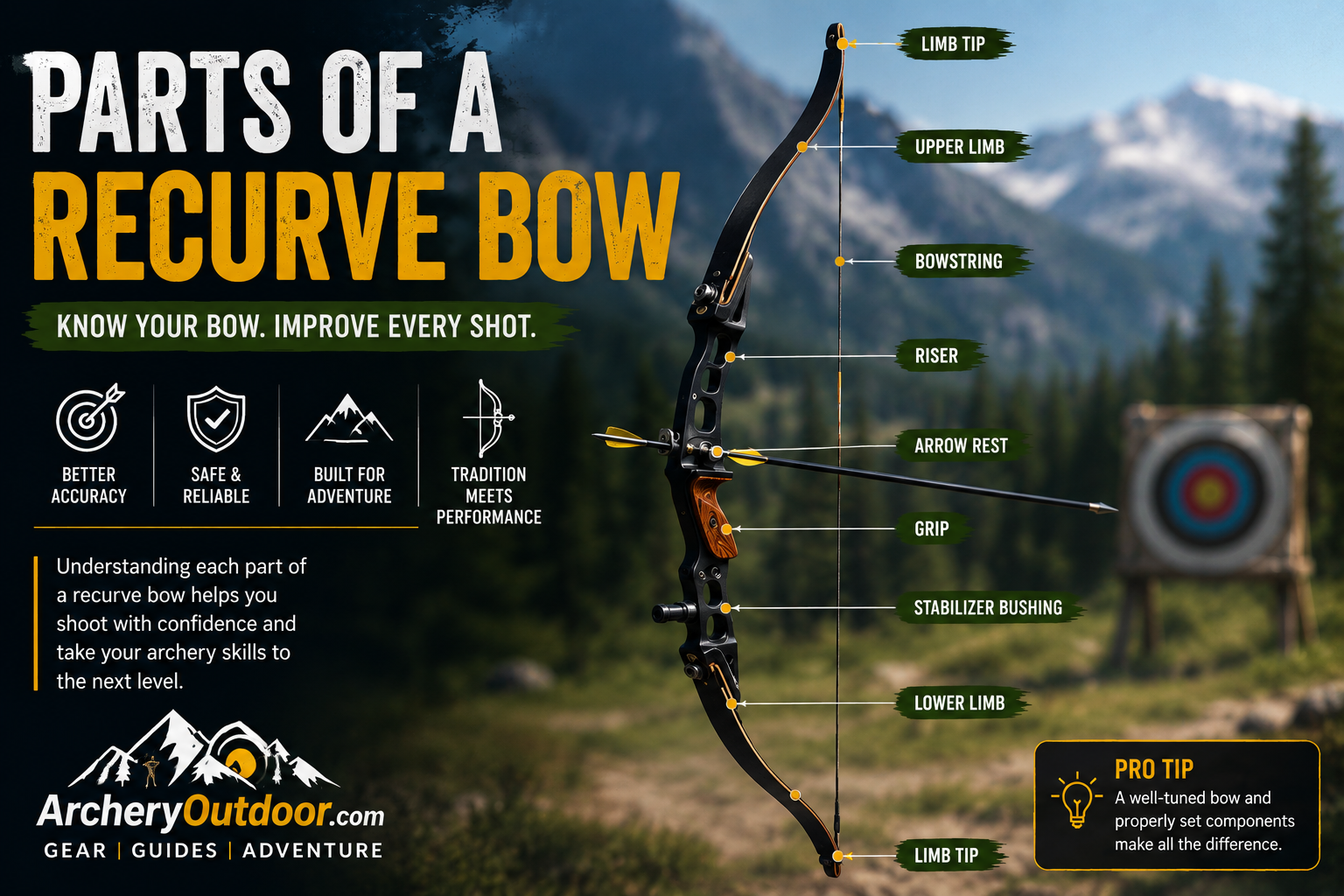

A recurve bow may look relatively simple compared with a compound bow, but every component has a specific purpose. Understanding the parts of a recurve bow can help beginners choose better equipment, troubleshoot common problems, improve their shooting setup, and understand how their bow works.
Whether you are learning archery at a local range, preparing for outdoor adventures, or researching your first traditional-style bow, knowing the parts of a recurve bow gives you a much stronger foundation.
In this guide, we will break down the major recurve bow parts, explain what each component does, and discuss optional accessories that can improve comfort, accuracy, and consistency.
What Is a Recurve Bow?
A recurve bow is a bow whose limbs curve away from the archer near the tips when the bow is unstrung. This distinctive shape gives the bow its name.
Compared with a simple traditional longbow, the recurve design can store and transfer energy efficiently while maintaining a relatively compact overall length.
Recurve bows are available in several configurations. Traditional recurves may have a simple riser and limbs, while modern target recurves can include sights, stabilizers, clickers, plungers, and other accessories.
Therefore, not every recurve bow will contain exactly the same components.
Understanding the parts of a recurve bow starts with separating the basic components from optional accessories.
Parts of a Recurve Bow
The main parts of a recurve bow include:
- Riser
- Upper limb
- Lower limb
- Limb tips
- Bowstring
- String nocking points
- Grip
- Limb bolts or limb attachment system
- Tiller adjustment system
- Sight mounting area
- Arrow rest
- Stabilizer bushing
- Plunger/button
- String serving
- Optional accessories
Not every bow will have every component listed above.
For example, a traditional recurve may have a simple arrow shelf instead of a separate arrow rest and may not have a sight or stabilizer.
Now let's examine each component in detail.
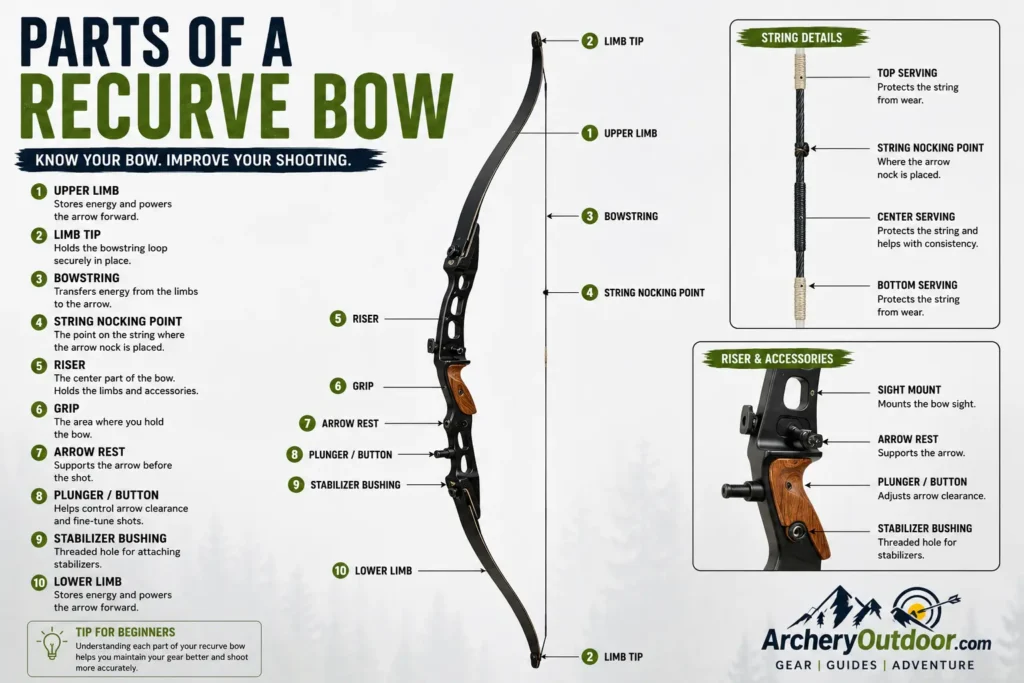
1. Riser
The riser is the central section of a modern recurve bow.
It is the part you hold while shooting and is typically manufactured from materials such as aluminum, magnesium alloy, carbon, wood, or composite materials.
The riser connects the upper and lower limbs and often contains mounting points for accessories.
When studying the parts of a recurve bow, the riser is one of the most important components to understand because it acts as the central platform for the entire bow.
What Does the Riser Do?
The riser provides:
- Structural support
- Limb attachment points
- Grip area
- Arrow rest mounting
- Sight mounting
- Stabilizer mounting
- Plunger mounting
- Other accessory mounting points
Modern target risers can contain multiple threaded holes that allow archers to customize their equipment.
Why Is Riser Design Important?
Different risers can have different:
- Lengths
- Weights
- Geometries
- Balance characteristics
- Mounting systems
- Materials
These differences can affect how a bow feels in your hand.
For beginners, however, comfort and appropriate setup are generally more important than simply choosing the most expensive riser.
2. Upper Limb
The upper limb is one of the primary energy-storing components of a recurve bow.
It extends from the upper portion of the riser toward the upper limb tip.
When you draw the bow, the limbs bend and store energy. When you release the string, that stored energy contributes to the acceleration of the arrow.
What Should You Look for in an Upper Limb?
When inspecting your upper limb, look for:
- Visible damage
- Cracks
- Unusual separation
- Surface defects
- Signs of excessive wear
Never use damaged archery equipment without having it properly inspected by a qualified professional.
3. Lower Limb
The lower limb performs a similar role to the upper limb but attaches to the lower portion of the riser.
Together, the upper and lower limbs form the main flexible structure of the bow.
One of the interesting things about the parts of a recurve bow is that the limbs may look similar but are designed to work together within a specific bow configuration.
Upper vs. Lower Limb
The limbs may have different markings indicating where they belong.
Always install limbs according to the manufacturer's instructions.
Do not assume that visually similar limbs can be swapped between bows or positions.
4. Limb Tips
The limb tips are the outer ends of the limbs where the string attaches or changes direction around the ends.
Because they experience significant forces during shooting, they should be treated carefully.
Inspect the tips regularly and avoid impacts or modifications that are not approved by the manufacturer.
The limb tips are small, but they are still important parts of a recurve bow because they interact directly with the string.
5. Bowstring
The bowstring connects the upper and lower ends of the bow.
When the bow is strung, the string provides the connection between the limbs and creates the path through which energy is transferred to the arrow.
The string also contains several important areas that beginners should understand.
What Is String Serving?
Serving is additional thread wrapped around specific sections of the bowstring.
It helps protect areas that experience additional wear, particularly around contact points.
The serving near the center of the string is commonly called center serving.
Why Should You Inspect the String?
Regularly check the string for:
- Excessive fraying
- Damage
- Broken strands
- Significant wear
- Serving separation
A damaged string should be evaluated or replaced appropriately before continuing to shoot.
6. Nocking Point
The nocking point is the location on the string where the arrow's nock is positioned.
Some archers use a dedicated nocking point or nocking-point marker to create a consistent arrow position.
Consistency matters because changing the vertical position of the arrow can affect the bow's setup and arrow flight.
When learning the parts of a recurve bow, beginners sometimes overlook the nocking point because it is small. However, it plays an important role in creating a repeatable shooting setup.
7. Grip
The grip is the section of the riser where the archer places the bow hand.
A comfortable grip can help you maintain a repeatable hand position.
However, avoid squeezing the bow excessively.
Your grip should be appropriate for your bow and shooting technique, and you should follow instruction from a qualified coach when learning proper form.
Why Is Grip Position Important?
Small changes in hand position can affect how the bow sits in your hand and how it reacts during the shot.
For that reason, a consistent grip is one of the fundamentals of good archery technique.
8. Limb Attachment System
Modern recurve bows may use different systems for attaching the limbs to the riser.
Many modern takedown recurve bows use a system that allows the limbs to be removed from the riser.
This makes transportation and storage easier.
Why Are Removable Limbs Useful?
A takedown design can make it easier to:
- Transport the bow
- Store the equipment
- Change limbs
- Adjust the setup
- Replace components
This is particularly useful for outdoor enthusiasts who travel with their archery equipment.
9. Tiller Adjustment System
Modern recurve risers may have adjustment systems that allow the archer or technician to modify limb positioning and related setup characteristics.
Tiller refers to the relative measurement or relationship between the limbs and riser that can influence how the bow behaves.
Because bow geometry can be complex, beginners should avoid making random adjustments.
If you are unsure about a setting, consult the manufacturer's instructions or work with an experienced archery technician.
10. Arrow Rest
The arrow rest supports the arrow as it sits on the bow.
Modern recurve bows may use a separate stick-on or screw-mounted arrow rest.
Other recurve bows may use an integrated shelf.
Arrow Shelf vs. Arrow Rest
A traditional-style recurve may allow the arrow to sit directly on a shelf built into the riser.
A modern target recurve commonly uses a separate arrow rest.
Both approaches can work when the equipment is properly configured.
Understanding the arrow-support system is an important part of learning the parts of a recurve bow.
11. Plunger Button
A plunger button, also called a cushion plunger, is an adjustable component used on many modern recurve setups.
It is mounted near the arrow rest and interacts with the arrow as it leaves the bow.
The plunger can help with tuning and arrow alignment.
Do Beginners Need a Plunger?
Not necessarily.
A traditional recurve setup may not use one.
However, competitive and target archers often use plunger systems as part of a more advanced setup.
Because tuning a plunger involves understanding the relationship between the bow, arrow, and shooting technique, beginners may benefit from professional guidance.
12. Bow Sight
A sight is an optional accessory that provides an aiming reference.
Many target recurve bows use sights, while traditional and instinctive archers may shoot without one.
A sight generally attaches to the riser using a dedicated mounting point.
Why Use a Sight?
A sight can provide a more repeatable aiming reference.
However, simply installing a sight will not automatically make an archer accurate.
Good shooting still depends on:
- Consistent stance
- Proper anchor
- Repeatable grip
- Controlled release
- Appropriate equipment
- Regular practice
13. Stabilizer
A stabilizer is another optional component commonly found on modern target recurve bows.
It extends from the riser and can influence the bow's balance and handling characteristics.
Different stabilizer systems can have different lengths and configurations.
Do You Need a Stabilizer?
For recreational beginners, a stabilizer may not be necessary.
For target archers, however, a properly selected stabilizer can become an important part of the setup.
The right choice depends on the archer, bow, shooting discipline, and personal preferences.
14. Clicker
A clicker is an accessory commonly associated with target recurve archery.
It provides an audible or tactile reference for achieving a consistent draw length.
When the arrow reaches the intended position, the clicker activates and signals the archer to complete the shot sequence.
Should Beginners Use a Clicker?
A clicker is generally something to learn after developing basic shooting fundamentals.
Using one without understanding proper form can create unnecessary confusion.
A coach can help determine when it makes sense to introduce one.
15. Bowstring Serving
Serving deserves additional attention because it is a specific part of the string system.
Serving is wrapped around sections of the string to protect the underlying strands from wear.
The most commonly recognized areas include the center serving and servings near the string ends, depending on the bow design.
Regular inspection can help identify wear before it becomes a larger equipment problem.
16. String Nock Points
Nock points help establish where the arrow should sit vertically on the string.
Some setups use tied nocking points, while others use different forms of markers.
The goal is to provide a consistent arrow position.
A consistent nocking position is especially useful when you are trying to maintain repeatable shooting technique.
17. Bow String Groove
The limbs and their tips are designed to guide and retain the bowstring.
The string should sit correctly in the designated grooves according to the manufacturer's instructions.
Before shooting, always make sure the bowstring is properly seated.
Incorrect string placement can create equipment and safety problems.
18. Arrow Shelf
Traditional recurve bows frequently include an arrow shelf as part of the riser design.
The shelf provides a surface where the arrow can rest.
Some archers add appropriate protective material or a rest depending on their setup.
Why Does the Arrow Shelf Matter?
The shelf influences how the arrow sits relative to the bow.
Its design can vary considerably between traditional and modern recurves.
Therefore, when examining the parts of a recurve bow, it is useful to understand that not every bow uses the same arrow-support system.
19. Bowstring Silencers
String silencers are optional accessories installed on some bows.
They can reduce certain string vibrations and sound characteristics.
Traditional archers may use them for comfort and noise management.
However, accessories should always be compatible with the specific bowstring and installed according to appropriate guidance.
20. Bowstring Loop and Attachment Areas
The ends of the bowstring form loops that connect to the limb tips.
These areas are subject to repeated tension and movement.
Inspect them regularly as part of your equipment-check routine.
If the string appears damaged or excessively worn, stop using it until it has been appropriately evaluated.
Traditional vs. Modern Recurve Bow Parts
One reason beginners find the parts of a recurve bow confusing is that different recurve designs can look dramatically different.
A traditional recurve may include:
- Wooden riser
- Upper limb
- Lower limb
- Bowstring
- String nocking point
- Arrow shelf
A modern Olympic-style recurve may additionally include:
- Adjustable riser
- Detachable limbs
- Sight
- Plunger
- Stabilizer
- Clicker
- Adjustable limb system
- Specialized arrow rest
Neither configuration is automatically better.
The appropriate setup depends on your goals, experience, discipline, and personal preferences.
Parts of a Recurve Bow You Should Inspect Regularly
Understanding the equipment is only half the job. You should also know which components deserve regular inspection.
Check the Limbs
Look for visible damage, cracks, unusual separation, or other changes.
Never ignore structural damage.
Check the String
Look for excessive wear, fraying, damaged strands, or serving problems.
Check the Riser
Inspect mounting points and accessory attachments.
Make sure components are secure according to manufacturer specifications.
Check the Arrow Rest
Make sure the rest is properly positioned and securely attached.
Check Accessories
Inspect sights, stabilizers, plungers, clickers, and other attachments before practice.
A short inspection before every session is a worthwhile habit.
How the Parts of a Recurve Bow Work Together
The individual parts of a recurve bow are not independent.
They work together as a complete system.
When you draw the bow, the limbs flex and store energy. The string moves with the limbs and reaches the archer's anchor position. The arrow rests on its support system and is positioned against the string.
When the string is released, stored energy is transferred through the bowstring into the arrow.
The riser provides the central structure, while accessories such as the arrow rest, sight, plunger, and stabilizer can influence how the setup performs.
This is why changing one component can sometimes affect the behavior of the entire bow.
Choosing Recurve Bow Parts for Beginners
If you are buying your first recurve bow, you do not necessarily need every accessory available.
Start with the fundamentals.
A practical beginner setup may include:
- Appropriate recurve bow
- Correctly matched arrows
- Bowstring
- Arrow rest or appropriate shelf setup
- Finger protection
- Arm guard
- Target
- Stringing device when appropriate for the bow
- Safe storage solution
Once you develop your technique, you can explore additional accessories.
Don't Buy Accessories Just Because They Look Advanced
Modern archery equipment can become highly specialized.
It can be tempting to purchase sights, stabilizers, clickers, upgraded rests, and other accessories immediately.
However, learning the fundamentals should come first.
A simple setup that you understand is often more useful than a complicated setup that you cannot properly tune or maintain.
Parts of a Recurve Bow and Their Functions
| Recurve Bow Part | Main Function |
|---|---|
| Riser | Central structure and grip |
| Upper Limb | Stores and releases energy |
| Lower Limb | Stores and releases energy |
| Limb Tips | Connect and guide the string |
| Bowstring | Transfers stored energy to the arrow |
| Nocking Point | Positions the arrow on the string |
| Grip | Provides the bow-hand contact area |
| Arrow Rest | Supports the arrow |
| Arrow Shelf | Supports arrows on some traditional bows |
| Plunger | Helps with arrow positioning and tuning |
| Sight | Provides an aiming reference |
| Stabilizer | Influences balance and handling |
| Clicker | Helps provide a consistent draw reference |
| Serving | Protects sections of the bowstring |
Common Questions About Parts of a Recurve Bow
What are the main parts of a recurve bow?
The main parts of a recurve bow are the riser, upper limb, lower limb, limb tips, bowstring, grip, and arrow-support system. Modern bows may also include sights, plungers, stabilizers, and clickers.
What is the most important part of a recurve bow?
There is no single component that can be considered the most important. The riser, limbs, and string form the primary bow system, while each component has a specific role.
What is the riser on a recurve bow?
The riser is the central section of the bow. It contains the grip and often provides mounting points for limbs and accessories.
What are recurve bow limbs?
The limbs are the flexible components attached to the riser. They bend during the draw cycle and store energy that contributes to arrow movement.
What does a plunger do on a recurve bow?
A plunger is an adjustable component used on many modern recurve setups to help position and tune the arrow as part of the overall bow-and-arrow system.
Do all recurve bows have sights?
No. Traditional recurves are often shot without sights, while modern target recurves frequently use them.
Do all recurve bows have an arrow rest?
No. Some bows use a dedicated arrow rest, while traditional designs may use an integrated arrow shelf.
What is the difference between a traditional and modern recurve bow?
Traditional recurves generally have simpler designs and fewer accessories. Modern recurve bows often feature modular components and mounting points for sights, stabilizers, plungers, and other equipment.
Final Thoughts on the Parts of a Recurve Bow
Understanding the parts of a recurve bow is one of the best ways to become more confident with your equipment. Once you know what the riser, limbs, string, arrow rest, nocking point, and optional accessories do, it becomes much easier to understand how your complete setup works.
For beginners, start with the essential components and learn how they interact before adding advanced accessories. As your experience grows, you can explore sights, stabilizers, plungers, clickers, and other equipment that may suit your shooting style.
Most importantly, inspect your equipment regularly and follow the manufacturer's instructions for setup, maintenance, and safe use. If you discover damage or are unsure about a technical adjustment, seek help from a qualified archery professional.
Whether you are practicing at a range, exploring traditional archery, or preparing for outdoor adventures, knowing the parts of a recurve bow gives you a stronger foundation for making informed equipment decisions and developing better archery habits.
For more archery guides, equipment advice, outdoor skills, and gear reviews, explore ArcheryOutdoor.com.