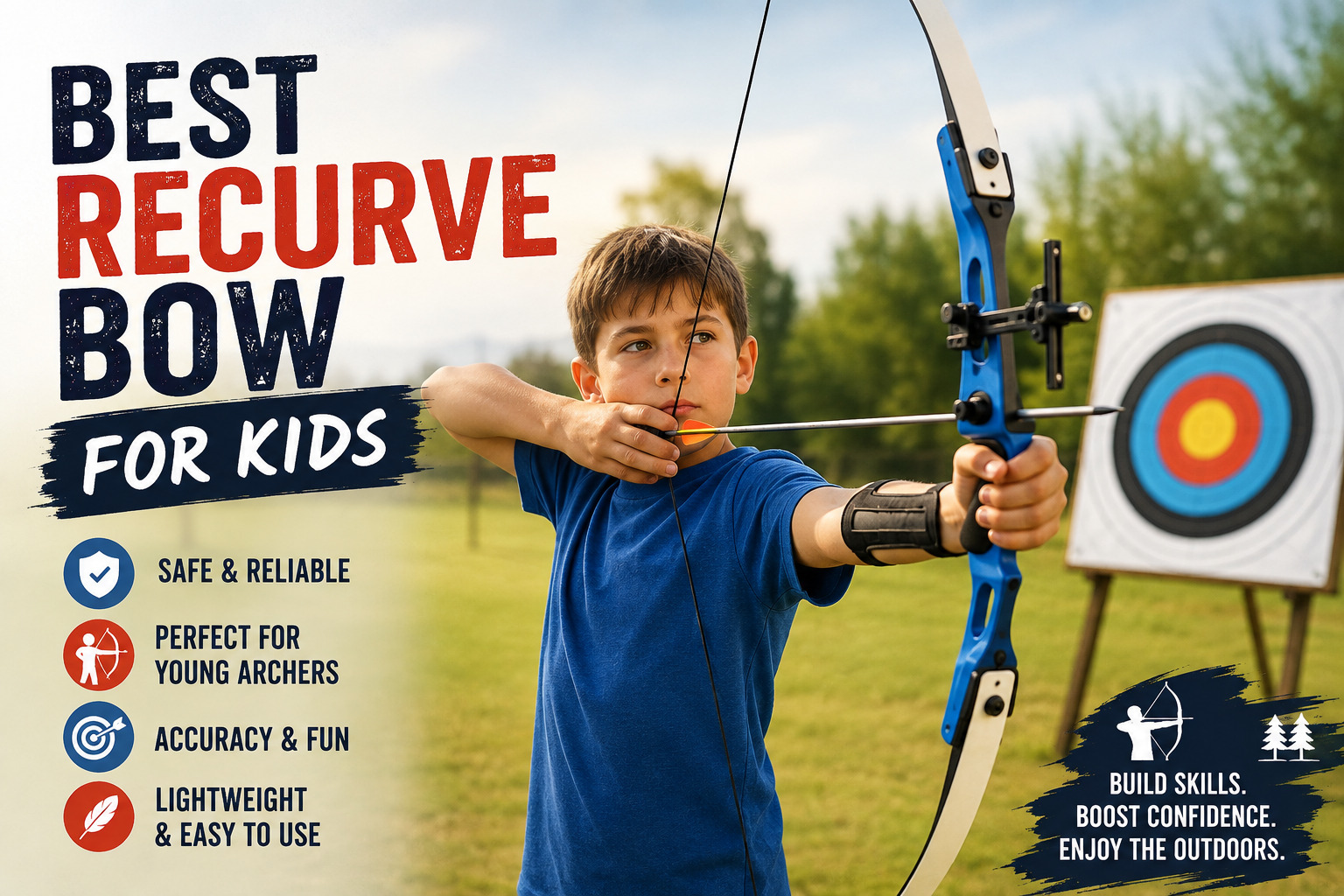

Recurve archery can be an exciting way for young outdoor enthusiasts to discover a new sport, build concentration, and enjoy time in a structured environment. However, because archery involves equipment that can cause serious injury when handled incorrectly, youth archery should always take place under appropriate adult supervision and qualified instruction.
Finding the best youth archery recurve bows requires balancing manageable draw weights, proper bow length, and essential safety gear. It’s not just about picking something that looks cool; it’s about establishing a safe, encouraging foundation that builds confidence and prevents injury.
If you are on the hunt for the best recurve bow for kids, you are in the right place. In this comprehensive review and safety guide, we will break down the top models available on the market today, explain the technical jargon in plain English, and provide a roadmap for setting up your backyard range safely.
Whether your child was inspired by the Olympics, a favorite movie character, or simply wants to join you on a 3D target course, the correct equipment is the single most important factor in their early success.
Why Choose a Recurve Bow for a Child?
When entering the world of archery, parents are often faced with a choice between compound bows and recurve bows. While compound bows feature complex cam systems and let-off mechanics, recurve bows offer a pure, foundational experience.
- Simplicity and Maintenance: Recurve bows are elegant in their simplicity. They consist of a riser (the handle) and two curved limbs. There are no cables to snap, no cams to derail, and no mechanical releases required. This makes maintenance incredibly easy and inexpensive.
- Developing True Form: Because a recurve bow holds its peak weight at full draw, it forces the archer to develop strong back tension and a clean release. A child who learns to shoot a recurve properly will easily transition to a compound bow later, whereas the reverse is often much more difficult.
- Cost-Effectiveness: The best youth archery recurve bows are highly affordable. Furthermore, many models are "takedown" bows, meaning the limbs can be unscrewed from the riser. As your child grows stronger, you can simply purchase heavier limbs for around $40-$75 instead of buying an entirely new bow.
How to Choose the Best Youth Archery Recurve Bows
Selecting the best recurve bow for kids is a science. You cannot simply guess their size. Here is the technical breakdown of what you must measure and consider before making a purchase.
1. Determining Eye Dominance (Crucial Step)
Before you even look at a bow, you must determine your child's eye dominance. Archery is a hand-eye coordination sport, and you shoot based on your dominant eye, not your dominant hand. A right-handed child with a left-dominant eye should ideally shoot a left-handed bow.
The Point Test: Have your child hold their arms out in front of them and form a small triangle with their thumbs and index fingers. Tell them to look through the triangle with both eyes open and center it on a distant object (like a doorknob). Next, have them close their left eye. If the object remains centered, they are right-eye dominant. If the object jumps out of the frame, they are left-eye dominant.
2. Measuring Draw Length
Draw length is the distance from the string at full draw to the lowest part of the grip. It dictates the length of the bow your child needs.
To find a child's draw length:
- Have them stand tall and spread their arms out wide (like an airplane).
- Measure from the tip of one middle finger to the tip of the other middle finger in inches.
- Divide that number by 2.5.
- Example: A 50-inch wingspan / 2.5 = 20-inch draw length.
3. Selecting the Right Bow Length
Once you know the draw length, you can select the bow length. A bow that is too short will "stack" (the string angle becomes too sharp, pinching the fingers and dramatically increasing resistance). A bow that is too long will be unwieldy.
- Draw Length up to 20": 48-inch bow length
- Draw Length 20" to 22": 54-inch bow length
- Draw Length 22" to 24": 62-inch bow length
- Draw Length 24" and above: 66-inch bow length
4. Choosing the Correct Draw Weight
This is where most parents make a critical error: they buy a bow with too much draw weight. "Overbowing" a child ruins their form and can cause shoulder injuries. The best recurve bow for kids should feel almost effortlessly light at first so they can focus on aiming and technique.
- Ages 5-8: 10 to 15 lbs maximum
- Ages 9-12: 15 to 20 lbs
- Ages 13-15: 20 to 25 lbs
- Ages 16+ (Beginner): 25 to 30 lbs
To make this sizing process completely seamless, you can use interactive calculators to map out exactly what your young archer needs based on their height and age.
🏹 Youth Bow Size Calculator
5 Best Recurve Bows for Kids & Young Beginners
Based on durability, upgradeability, safety, and real-world performance, here are the top 5 best youth archery recurve bows dominating the market in 2026.
1. SAS Spirit Junior (The Top All-Around Performer)
The Southland Archery Supply (SAS) Spirit Junior consistently ranks as the best recurve bow for kids in the 54-inch category. It is a takedown recurve made with a beautiful laminate of chuglam, gmelina arborea, and beech woods. The fiberglass limbs are highly durable and resistant to the occasional dry fire.
- Key Features: 54-inch length, takedown design (removable limbs), pre-drilled brass bushings for accessories.
- Draw Weights: 12, 16, or 22 lbs
- Best For: Ages 9-13
Pros:
- Grows with the Archer: You can purchase heavier limbs separately as your child gains strength.
- Highly Customizable: Pre-drilled holes allow you to easily add mechanical sights, stabilizers, or plungers later on.
- Excellent Value: Strikes the perfect balance between high-end quality and an approachable price point.
Cons:
- Basic String Included: The factory string is functional but basic; you may want to upgrade to a higher-quality Dacron string after a few months.
- Size Constraint: At 54 inches, it is slightly too long and unwieldy for children under 8 years old.
2. Samick Sage Junior (The Legendary Standard)
If you know archery, you know the Samick Sage. It is the most recommended beginner bow in history, and the Junior version brings that identical quality down to a 54-inch frame.
- Key Features: 54-inch length, hard maple and Dymondwood riser, reinforced black fiberglass and maple limbs.
- Draw Weights: 14 to 25 lbs
- Best For: Ages 10-14 who are serious about learning the sport.
Pros:
- Exceptional Build Quality: The quality control is unmatched in this price bracket, offering an incredibly smooth draw cycle without stacking.
- High Resale Value: Because of the brand's reputation, you can easily resell this bow when your child outgrows it.
- Toolless Assembly: The limb bolts feature oversized knurled knobs, meaning you can assemble and disassemble the bow without an Allen wrench.
Cons:
- Higher Price Point: It is generally more expensive than other entry-level youth bows.
- Slightly Heavier Riser: The dense Dymondwood makes the bow physically heavier in the hand, which can fatigue smaller arms faster.
3. Bear Archery Little Bear (The Best Traditional Option)
For parents who want to pass down a piece of American archery heritage, the Bear Archery Little Bear is a stunning one-piece recurve. Unlike takedown bows, this is crafted from a single continuous piece of laminated hardwood and backed with fiberglass.
- Key Features: 48-inch one-piece construction, traditional off-the-shelf shooting design, brown glass limbs.
- Draw Weights: 15 to 20 lbs
- Best For: Ages 5-9 seeking a premium, traditional experience.
Pros:
- Ultra-Lightweight: Without heavy metal limb bolts or brackets, this bow is incredibly light, allowing small children to hold their aim steady for longer.
- No Assembly Required: It is a single piece of wood; simply string it and shoot.
- Instinctive Training: Because there are no mounting holes for sights, it perfectly teaches traditional, instinctive hand-eye coordination.
Cons:
- No Upgrades: Because it is a one-piece bow, you cannot swap out the limbs for a heavier weight. You must buy a completely new bow when they outgrow it.
- No Accessory Mounts: You cannot attach stabilizers or modern aiming sights.
4. Keshes Takedown Youth Set (The Best Budget Starter Kit)
If you are testing the waters and aren't sure if your child will stick with archery, the Keshes Takedown set is a phenomenal entry point. It bundles everything you need to start shooting immediately in one accessible package.
- Key Features: Available in 54 or 62 inches, ergonomic wooden grip, includes bow, string, stick-on arrow rest, and stringer tool.
- Draw Weights: 15 to 35 lbs
- Best For: Budget-conscious families wanting an all-in-one starter box.
Pros:
- Complete Kit: Includes the crucial stringer tool and arrow rest, saving you from making separate purchases.
- Durable: The limbs are rugged and can take a beating at summer camp or in the backyard.
- Wide Weight Range: Offers poundage options up to 35 lbs, making it suitable for older teens as well.
Cons:
- Wood Finish Quality: The clear coat and wood finishing are not as refined as the Samick or SAS models.
- Hardware Loosening: The limb bolts can occasionally vibrate loose after heavy shooting sessions; they require regular tightening checks.
5. Genesis Original (The Universal Trainer)
While technically a hybrid and not a pure recurve, the Genesis Original must be mentioned in any discussion about the best youth archery recurve bows because it is the official bow of the National Archery in the Schools Program (NASP).
- Key Features: 35.5-inch axle-to-axle length, machined aluminum riser, zero let-off single cam system.
- Draw Weights: Adjustable from 10 to 20 lbs (requires an Allen wrench).
- Best For: Families with multiple kids of different ages sharing equipment.
Pros:
- One Size Fits All: There is no specific draw length requirement. A 6-year-old and an adult can shoot the exact same bow consecutively without changing any settings.
- Indestructible Build: Built with a machined aluminum riser and tough composite limbs, it is designed to survive heavy institutional use.
- Adjustable Weight: You can dial the weight down to 10 lbs or up to 20 lbs directly on the bow without buying new parts.
Cons:
- Heavy Physical Weight: The metal riser makes the bow weigh nearly 3 lbs, which can be exhausting for a 5-year-old to hold up.
- Non-Traditional Look: It looks and feels like a compound bow, which may not appeal to kids who want the classic "Robin Hood" aesthetic.
Recurve Bow Quick Comparison Matrix
| Model | Recommended Age | Draw Weight Range | Takedown Design? | Key Advantage |
| SAS Spirit Junior | 8–13 Years | 14 – 20 lbs | Yes | Easy limb upgrades as archer grows |
| Bear Little Bear | 5–10 Years | 20 – 25 lbs | No | Ultra-lightweight & classic design |
| Keshes Youth Set | 10+ Years | 15+ lbs | Yes | Complete starter kit with safety gear |
| SinoArt Youth | 7–12 Years | 15 – 20 lbs | Yes | Best budget-friendly complete set |
| Samick Sage | 12+ Years | 25+ lbs | Yes | Benchma |
The Essential Safety Gear Checklist
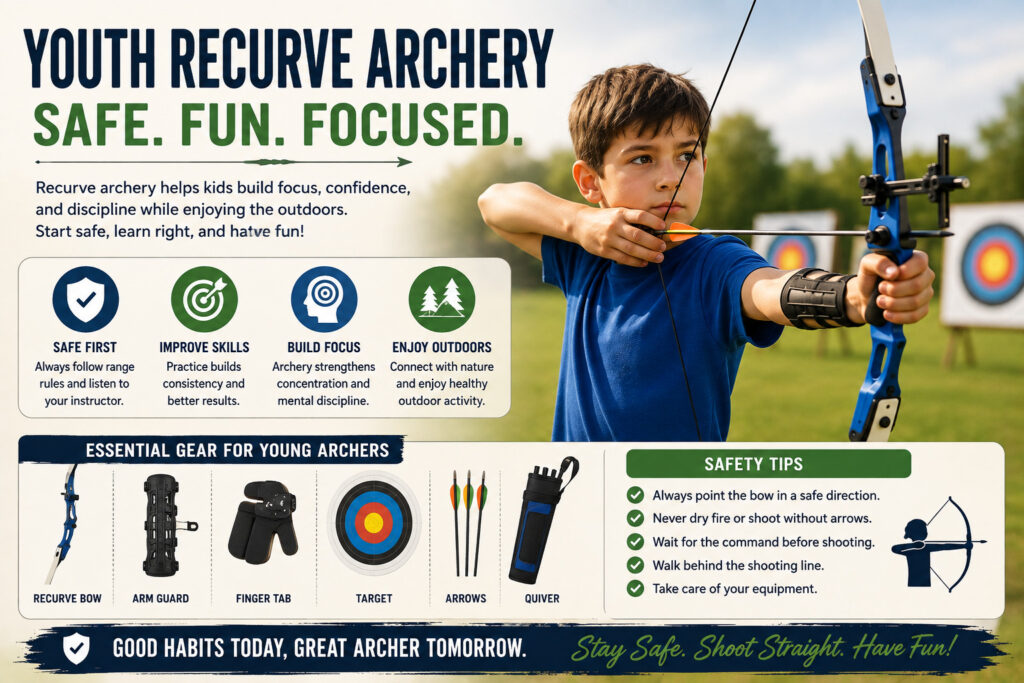
Buying the best recurve bow for kids is only step one. Archery requires protective equipment to ensure a pain-free experience. If a child slaps their arm with a bowstring on day one, they may never want to shoot again.
- The Arm Guard (Bracer): This is non-negotiable. A recurve bowstring travels forward with immense force. Even with perfect form, string slap happens. An arm guard protects the fragile skin on the inside of the forearm.
- Finger Tab or Glove: Pulling back a thin Dacron or FastFlight string repeatedly will cause deep blisters on small fingers. A leather finger tab or a three-finger shooting glove absorbs the pressure.
- Bow Stringer: You must never bend a recurve bow over your knee to string it; this twists the limbs and ruins the bow. A bow stringer is a cheap, safe cord system used to leverage the limbs safely when installing the string.
- Target Backstop: A foam block target is great, but arrows can miss. Ensure you have a heavy rubber stall mat or specialized archery netting hung loosely behind the target to catch stray arrows. Never shoot toward fences that border neighbors' yards.
Range Etiquette and Safety Rules to Teach on Day One
Before handing over the best youth archery recurve bows to your children, you must establish range commands. Treating a bow with the same respect as a firearm is the foundation of archery safety.
- "Range is Hot" / "Clear to Shoot": No one crosses the firing line. Arrows can be nocked (loaded onto the string).
- "Bows Down" / "Clear to Retrieve": All bows are placed on the ground or a rack. Only then can archers walk downrange to pull their arrows from the target.
- The Dry Fire Rule: The most important mechanical rule of archery. Never pull the string back and let it go without an arrow nocked. Without an arrow to absorb the kinetic energy, the force violently reverberates through the bow, instantly splintering fiberglass limbs and potentially injuring the archer.
5 Common Mistakes Parents Make
- Buying from Big Box Toy Aisles: Plastic "toy" bows with suction cups are fine for toddlers, but fiberglass-rod bows sold in big box stores with heavy, stacking draw curves teach terrible habits. Stick to proper laminated wooden takedowns.
- Ignoring Arrow Spine: You cannot buy a great bow and pair it with cheap, untuned arrows. Arrows flex when fired (The Archer's Paradox). The flexibility is called the "spine." A low-poundage youth bow requires highly flexible, high-spine arrows (like an 800 or 1000 spine carbon arrow) to fly straight.
- Skipping the Stringer: As mentioned above, hand-stringing a bow voids warranties and causes permanent limb twist. Always use the stringer.
- Forcing Right-Handed Shooting on Left-Eye Dominant Kids: We covered this earlier, but it bears repeating. If your child struggles to aim, re-check their eye dominance.
- Too Much Bow: Always err on the lighter side for draw weight. Archery is about precision and repetition, not brute strength.
Conclusion
Investing in the best youth archery recurve bows gives young archers a safe, structurally sound foundation in the sport. Whether you choose the timeless elegance of the Bear Archery Little Bear, the modular versatility of the Samick Sage Junior, or the shared-family convenience of the Genesis Original, the key is prioritizing a low draw weight and perfect form.
Equip them with an arm guard, teach them the safety commands, and enjoy watching their focus and confidence grow with every bullseye. Archery is a lifelong journey, and starting with the best recurve bow for kids ensures that the first steps on that journey are successful and joyful.