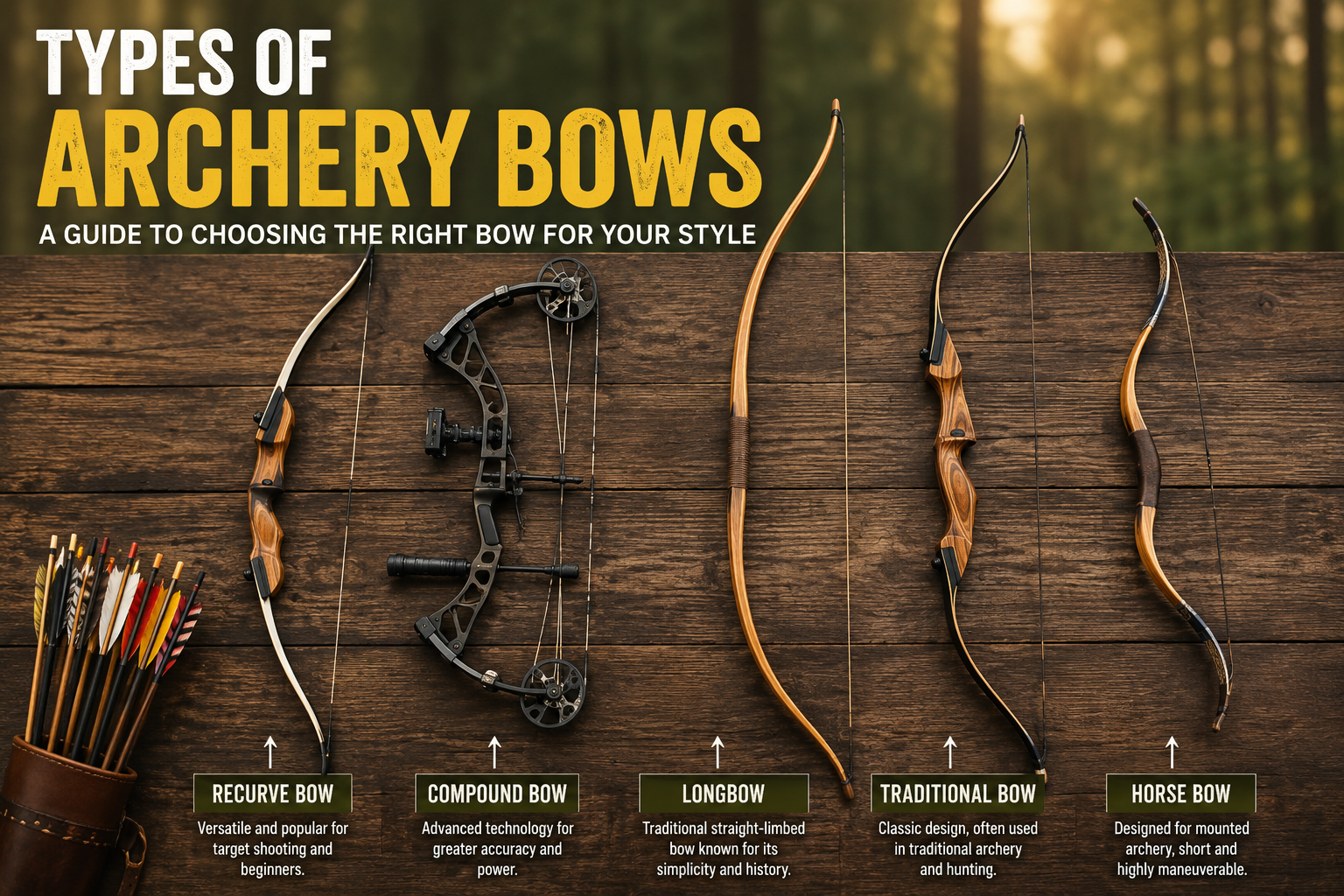

If you're planning to start archery, one of the first questions you'll probably ask is, "Which type of archery bow should I choose?" It's an important decision because the right bow can make learning easier, improve your accuracy, and keep the sport enjoyable from day one.
Many beginners assume that all bows work the same way. In reality, every bow is designed for a different purpose. Some are built for Olympic target shooting, while others are made for hunting, traditional archery, or recreational target practice. They also vary in size, draw weight, speed, materials, and overall shooting experience.
Buying the first bow you see online without understanding these differences often leads to disappointment. Before investing in your first setup, it's helpful to understand the different types of archery bows, how they work, and the basic parts that make up each bow. This knowledge will help you choose equipment that matches your goals, whether you want to compete, hunt, or simply enjoy shooting at the range.
In this guide, I'll explain the most popular types of archery bows, discuss the main components of a bow, compare their strengths and weaknesses, and share practical buying tips to help you choose the right equipment with confidence.
What Is an Archery Bow?
An archery bow is a specially designed tool that stores energy when the string is pulled back and releases that stored energy to propel an arrow toward a target. Although the basic principle has remained the same for thousands of years, modern bows are more accurate, efficient, and durable thanks to advanced materials and engineering.
Archery has evolved from a survival skill into one of the world's most popular sports and recreational activities. Today, people use bows for target shooting, Olympic competition, field archery, 3D archery, bowhunting (where legal), and simple backyard practice. Each discipline requires a slightly different bow design, which is why several types of archery bows are available.
At first glance, buying a bow may seem simple. You search online, compare prices, and purchase one with the highest ratings. However, this approach often leads beginners to buy equipment that doesn't match their skill level or intended use. A poorly chosen bow can affect your shooting form, accuracy, comfort, and overall enjoyment of the sport.
That's why understanding the different types of bows and their components is one of the most important first steps before making a purchase.
A Brief History of Archery Bows
Archery has been part of human civilization for thousands of years. Early bows were crafted from a single piece of wood and were primarily used for hunting and protection. As civilizations advanced, bow designs became more specialized.
Ancient cultures such as the Egyptians, Persians, Mongols, Chinese, and English each developed bows suited to their environment and style of warfare. The famous English longbow dominated medieval battlefields, while compact horse bows allowed mounted warriors to shoot accurately while riding.
Today, archery has evolved into a modern sport with advanced materials like aluminum, carbon fiber, fiberglass, and high-performance synthetic strings. Although technology has changed dramatically, the fundamental principle of storing and releasing energy remains exactly the same.
How Does an Archery Bow Work?
The science behind an archery bow is surprisingly simple.
When you pull the bowstring, the limbs bend backward and store elastic potential energy. As soon as you release the string, that stored energy is transferred through the bowstring into the arrow, converting it into kinetic energy. The arrow then travels toward the target at high speed.
Several factors influence how efficiently a bow transfers energy, including:
- Bow design
- Limb material
- Draw weight
- Draw length
- Bowstring quality
- Arrow weight
Modern bows are designed to maximize this energy transfer, allowing arrows to fly faster, straighter, and more consistently than traditional designs.
Why Are There Different Types of Archery Bows?
One of the biggest mistakes beginners make is assuming that every bow performs the same. In reality, each type of bow is designed with a specific purpose in mind.
Some bows prioritize accuracy, while others focus on speed, simplicity, portability, or historical authenticity.
For example:
- Olympic athletes use highly adjustable recurve bows with stabilizers and sights for maximum precision.
- Hunters often prefer compound bows because their cam systems provide greater speed and holding power.
- Traditional archers enjoy longbows and horse bows for their simple construction and historical appeal.
- Recreational shooters usually choose beginner-friendly recurve bows because they are easy to learn and affordable.
Understanding these differences helps you choose equipment that fits your goals instead of buying a bow based solely on appearance or price.
Types of Archery Bows
Choosing the right bow starts with understanding the different designs available. Every bow offers a unique shooting experience and is built for a specific purpose.
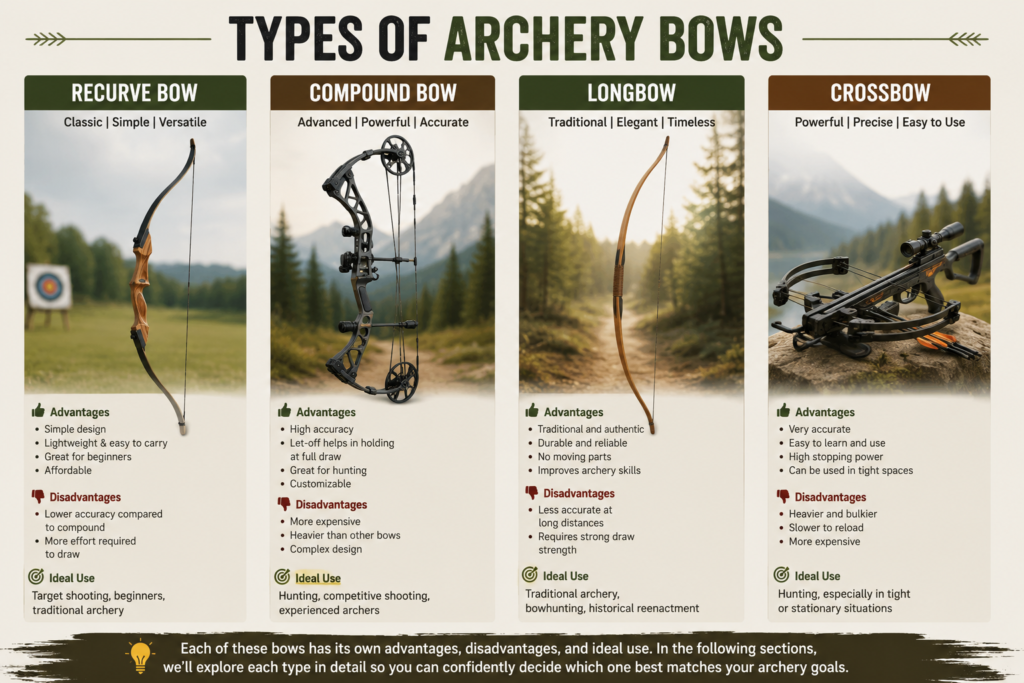
The most popular types of archery bows include:
- Recurve Bow
- Compound Bow
- Longbow
- Crossbow
Each of these bows has its own advantages, disadvantages, and ideal use. In the following sections, we'll explore each type in detail so you can confidently decide which one best matches your archery goals.
1. Recurve Bow: The Most Popular Choice for Beginners
The recurve bow is the most recognizable and widely used type of archery bow in the world. Whether you're taking your first archery lesson, practicing at a local club, competing in the Olympics, or enjoying recreational target shooting, there's a good chance you'll start with a recurve bow.
Its simple design, smooth shooting experience, and affordable price make it an excellent choice for beginners. At the same time, high-end recurve bows are also used by professional archers at the highest level of international competition.
Unlike other bow designs, the limbs of a recurve bow curve away from the archer at the tips. This distinctive shape allows the bow to store more energy and deliver it more efficiently to the arrow. As a result, a recurve bow can shoot faster and more smoothly than a traditional straight-limbed bow of the same draw weight.
Whether your goal is target shooting, recreational archery, or eventually hunting (where legally permitted), a recurve bow provides an excellent foundation for developing proper shooting technique.
Why Is It Called a Recurve Bow?
The name "recurve" comes from the unique shape of its limbs.
Instead of remaining straight, the limb tips curve forward away from the shooter. When the bow is drawn, these curved tips store additional energy before transferring it to the arrow upon release.
This clever design offers several advantages:
- Faster arrow speeds
- Better energy efficiency
- Smoother draw cycle
- Reduced hand shock
- Improved shooting performance
Although the curved limb design may appear simple, it has been refined over centuries and remains one of the most efficient bow designs ever created.
Why Beginners Love Recurve Bows?
If someone asks me which bow they should buy for their first archery experience, I usually recommend a recurve bow.
There are several reasons for this recommendation.
1.Easy to Learn
Recurve bows encourage beginners to develop proper shooting form instead of relying on mechanical assistance. Learning correct posture, anchor point, grip, and release early makes it much easier to progress as your skills improve.
2.Affordable
Compared with compound bows, recurve bows are generally much less expensive.
A quality beginner recurve setup costs significantly less while still providing excellent performance for practice and recreational shooting.
3.Lightweight
Most recurve bows are lighter than compound bows because they don't use cams, pulleys, or cables.
This lighter weight makes longer practice sessions more comfortable, especially for beginners.
4.Easy Maintenance
A recurve bow has fewer moving parts.
There are no cams to synchronize or cables to adjust, making maintenance much simpler.
With regular string waxing and occasional inspections, a quality recurve bow can last for many years.
5.Excellent for Skill Development
Many experienced archers believe learning on a recurve bow builds stronger shooting fundamentals.
Since every shot depends entirely on the archer's technique, beginners quickly learn proper alignment, balance, breathing, and release.
These skills transfer easily if you later switch to another style of bow.
Types of Recurve Bows
Although all recurve bows share the same basic limb design, they are available in several different styles.
Choosing the right one depends on how you plan to use it.
1. Olympic Recurve Bow
Olympic recurve bows are designed specifically for competitive target archery.
These bows use modern aluminum or carbon risers combined with high-performance limbs and precision accessories such as:
- Adjustable sights
- Stabilizers
- Clickers
- Plungers
- V-bars
- Long rods
Every component is designed to maximize consistency and accuracy over long distances.
If you've ever watched Olympic archery, you've seen this style of bow in action.
2. Traditional Recurve Bow
Traditional recurve bows focus on simplicity.
Most are made from wood or laminated materials and are often shot without sights or stabilizers.
Many archers enjoy these bows because they provide a more instinctive shooting experience and preserve the traditional feel of archery.
3. Hunting Recurve Bow
Hunting recurve bows are typically shorter than target models.
Their compact size makes them easier to carry through forests or rough terrain while stalking game.
Many hunting recurves feature:
- Wooden risers
- Camouflage finishes
- Compact limbs
- Higher draw weights
Although simpler than compound bows, hunting recurves require excellent shooting technique and consistent practice.
4. Take-Down Recurve Bow
One of the most popular options today is the take-down recurve bow.
Instead of being built as a single piece, it consists of three main components:
- One riser
- Upper limb
- Lower limb
These pieces can be assembled or disassembled within minutes.
This design offers several important advantages:
- Easier transportation
- Convenient storage
- Replaceable limbs
- Easy draw-weight upgrades
Many beginners purchase a take-down recurve because they can simply replace the limbs with heavier ones as their strength improves instead of buying an entirely new bow.
Advantages of a Recurve Bow
A recurve bow offers many benefits for both beginners and experienced archers.
Pros
- Beginner friendly
- Affordable compared to compound bows
- Lightweight and portable
- Easy to maintain
- Excellent for learning proper technique
- Used in Olympic competition
- Wide variety of accessories
- Replaceable limbs on take-down modelsSuitable for target shooting, recreational shooting, and hunting (where permitted)
Disadvantages of a Recurve Bow
Like every bow, recurves also have a few limitations.
Cons
- Requires more practice than a compound bow
- No let-off at full draw
- Holding heavy draw weights becomes tiring
- Slightly slower than compound bows
- Accuracy depends heavily on shooting technique
Despite these challenges, many archers enjoy the satisfaction that comes from mastering a recurve bow through consistent practice.
Who Should Buy a Recurve Bow?
A recurve bow is an excellent choice if you:
- Are completely new to archery
- Want to improve your shooting form
- Plan to shoot at a local club
- Want to compete in Olympic-style target archery
- Prefer a simple, reliable bow with fewer moving parts
- Need a budget-friendly option that can grow with your skills
For most beginners, a take-down recurve bow offers the best balance of performance, affordability, and long-term value.
Quick Specifications
| Feature | Recurve Bow |
|---|---|
| Best For | Beginners, target shooting, Olympic archery |
| Speed | Medium |
| Accuracy | High (with practice) |
| Difficulty | Easy to learn, challenging to master |
| Maintenance | Low |
| Typical Draw Weight | 15–50 lbs |
| Price Range | Budget to premium |
2. Compound Bow: Modern Precision and Maximum Performance
The compound bow is one of the most advanced types of archery bows available today. Unlike a recurve bow, a compound bow uses a system of cams, pulleys, cables, and highly efficient limbs to generate more power while reducing the amount of force required to hold the bow at full draw.
This innovative design allows archers to shoot with greater speed, consistency, and accuracy. Because of its mechanical advantage, the compound bow has become the preferred choice for many hunters and competitive target archers around the world.
Although compound bows may look more complicated than recurves, they offer impressive performance once properly adjusted. However, they require regular maintenance and careful tuning to perform at their best.
How Does a Compound Bow Work?
The defining feature of a compound bow is its cam system.
As you pull the string, the cams rotate and gradually increase the draw weight. Near the end of the draw cycle, the cams create what's known as let-off, dramatically reducing the amount of weight you need to hold before releasing the arrow.
For example, a bow with a 70-pound draw weight and 80% let-off requires only about 14 pounds of holding force at full draw.
This allows the archer to aim more steadily and maintain proper form for a longer period before taking the shot.
Why Hunters Prefer Compound Bows
Many hunters choose compound bows because they combine speed, power, and precision.
The higher arrow velocity helps deliver greater kinetic energy, making compound bows highly effective for ethical hunting where permitted by law.
Their compact design also makes them easier to carry through dense forests or hunting blinds compared to longer target bows.
In addition, accessories such as stabilizers, sights, peep sights, and release aids help improve accuracy even at longer distances.
Advantages of a Compound Bow
One of the biggest reasons for the popularity of compound bows is their impressive shooting performance.
1. Higher Arrow Speed
The efficient cam system transfers more stored energy to the arrow, allowing it to travel much faster than most traditional bows.
This flatter trajectory reduces arrow drop and improves long-distance accuracy.
2.Let-Off Makes Holding Easier
Unlike a recurve bow, which requires you to hold the full draw weight throughout the shot, a compound bow significantly reduces the holding weight at full draw.
This makes aiming easier and helps reduce fatigue during long practice sessions or hunting situations.
3.Outstanding Accuracy
Most compound bows are equipped with advanced accessories that improve shooting consistency.
These commonly include:
- Adjustable bow sights
- Peep sights
- Stabilizers
- Arrow rests
- Mechanical release aids
Together, these components help minimize human error and produce highly consistent groups.
4.Adjustable Draw Length
Many modern compound bows allow the draw length to be adjusted without replacing major components.
This makes them an excellent option for growing teenagers or archers who are still determining their ideal shooting form.
Disadvantages of a Compound Bow
Although compound bows offer excellent performance, they are not perfect for everyone.
1. Higher Cost
A quality compound bow setup usually costs more than a comparable recurve bow.
In addition to the bow itself, you'll likely need several accessories before you're ready to shoot.
2.More Maintenance
Because of the cam and cable system, compound bows require regular inspection and tuning.
Replacing strings or cables is generally more complicated and often requires specialized equipment.
3.Heavier Weight
Compound bows contain more mechanical components, making them noticeably heavier than most recurve bows.
Some archers appreciate the added stability, while others prefer the lighter feel of traditional bows.
4.Learning Curve
Although shooting can become easier thanks to let-off, beginners often need time to understand proper adjustment, tuning, and accessory setup.
Fortunately, most pro shops can help with the initial setup.
Types of Compound Bows
Modern compound bows are generally divided into two categories.
1.Target Compound Bow
These bows are built specifically for competitive target shooting.
They typically feature:
- Longer axle-to-axle length
- Larger stabilizers
- Bright colors
- Highly adjustable sights
- Smooth draw cycles
Their design prioritizes maximum stability and precision.
2. Hunting Compound Bow
Hunting compound bows are designed for portability and durability.
Common features include:
- Shorter overall length
- Camouflage finishes
- Higher arrow speeds
- Lightweight construction
- Compact limb design
Their smaller size makes them easier to maneuver in tree stands, blinds, or dense woodland.
Recurve Bow vs Compound Bow Comparision
Many beginners struggle to decide between these two popular bow styles.
Here's a quick comparison.
| Feature | Recurve Bow | Compound Bow |
|---|---|---|
| Beginner Friendly | ⭐⭐⭐⭐⭐ | ⭐⭐⭐ |
| Speed | Medium | Very High |
| Accuracy | High with practice | Excellent |
| Maintenance | Low | Moderate to High |
| Weight | Light | Heavier |
| Price | More affordable | More expensive |
| Olympic Use | Yes | No (Olympics) |
| Hunting | Yes | Excellent |
| Accessories | Optional | Essential |
Who Should Choose a Compound Bow?
A compound bow is an excellent choice if you:
- Want maximum accuracy.
- Plan to hunt where bowhunting is legal.
- Prefer modern technology over traditional shooting.
- Don't mind performing regular maintenance.
- Have a larger budget for your equipment.
- Want faster arrow speeds and reduced holding weight.
For beginners focused on learning proper technique, a recurve bow remains an excellent starting point. However, if your primary goal is hunting or precision target shooting, a compound bow can be a worthwhile investment.
Quick Specifications
| Feature | Compound Bow |
|---|---|
| Best For | Hunting, target shooting, experienced archers |
| Speed | Very High |
| Accuracy | Excellent |
| Maintenance | Moderate |
| Difficulty | Moderate |
| Typical Draw Weight | 40–70 lbs |
| Price Range | $$–$$$$ |
Longbow: The Traditional Bow That Shaped History
The longbow is one of the oldest and most iconic weapons in the history of archery. Known for its tall, straight design and smooth shooting characteristics, the longbow has been used for hunting, warfare, and sport for centuries. Although modern bows have introduced advanced technology, many archers still appreciate the simplicity and craftsmanship of a traditional longbow.
Unlike a recurve bow, a longbow has limbs that remain almost straight when unstrung. This simple construction gives it a classic appearance and a unique shooting experience that appeals to traditional archers around the world.
Today, longbows are commonly used for traditional target shooting, historical reenactments, recreational archery, and bowhunting where permitted by law.
What Is a Longbow?
A longbow is a tall, one-piece or take-down bow with long, gently curved limbs that do not recurve at the tips. Most traditional longbows are approximately the same height as the archer, usually ranging from 64 to 72 inches in length.
The long limbs distribute the draw weight smoothly, allowing the bow to shoot arrows quietly and consistently. While longbows generally produce slower arrow speeds than compound bows, they provide an enjoyable and natural shooting experience that many archers find rewarding.
History of the Longbow
The longbow has played an important role throughout history, especially in medieval Europe. It became famous during the Hundred Years' War, where skilled English archers used powerful longbows to achieve remarkable victories on the battlefield.
Long before firearms became common, the longbow was considered one of the most effective long-range weapons available. Experienced archers could shoot multiple arrows per minute while maintaining impressive accuracy over long distances.
Although military use has disappeared, the longbow remains an important symbol of traditional archery and continues to attract enthusiasts who appreciate its historical significance.
Longbow Design
One of the biggest differences between a longbow and other bows is its straightforward construction.
A traditional longbow usually consists of:
- A wooden riser and limbs formed from a single piece of wood or laminated hardwoods.
- A durable bowstring made from modern synthetic fibers or traditional materials.
- A simple grip without complex accessories.
- No cams, pulleys, stabilizers, or sights.
This minimalist design makes the longbow lightweight, quiet, and enjoyable to shoot.
Advantages of a Longbow
Many archers choose a longbow because of its simplicity and timeless appeal.
1. Traditional Shooting Experience
Longbows provide one of the purest forms of archery. Without mechanical aids, every shot depends entirely on the archer's skill, making each successful shot especially satisfying.
2.Lightweight Design
Most longbows weigh significantly less than compound bows, making them comfortable to carry during extended shooting sessions or while walking through the woods.
3.Quiet Performance
The simple design produces very little mechanical noise, making longbows popular among traditional hunters.
4. Easy Maintenance
Since a longbow has very few moving parts, maintenance is straightforward. Regular string waxing and occasional inspections are usually enough to keep the bow in excellent condition.
5.Beautiful Craftsmanship
Many traditional longbows are handcrafted from premium hardwoods such as yew, hickory, maple, or bamboo laminates. Their natural appearance makes them as attractive as they are functional.
Disadvantages of a Longbow
Although longbows have many strengths, they also require more skill to master.
1. Less Forgiving
Without sights or stabilizers, maintaining consistent accuracy requires excellent shooting form and plenty of practice.
2. Slower Arrow Speed
Compared to modern compound bows, longbows generally shoot arrows at lower speeds.
3.Longer Overall Length
Because of their size, longbows can be less convenient to transport and maneuver in tight spaces.
4.Steeper Learning Curve
Traditional shooting relies heavily on instinct and muscle memory, so beginners may need extra practice before achieving consistent accuracy.
Who Should Choose a Longbow?
A longbow is an excellent choice if you:
- Enjoy traditional archery.
- Appreciate handcrafted wooden equipment.
- Want a simple shooting experience without modern accessories.
- Participate in historical reenactments.
- Prefer instinctive shooting techniques.
- Want to improve your overall archery skills.
If your primary goal is competitive target shooting or Olympic-style archery, a recurve bow may be a better choice. However, if you value tradition and simplicity, a longbow offers a rewarding experience unlike any other.
Longbow Specifications
| Feature | Longbow |
|---|---|
| Best For | Traditional archery, recreation, hunting |
| Speed | Moderate |
| Accuracy | Good with experience |
| Maintenance | Low |
| Beginner Friendly | Moderate |
| Typical Length | 64–72 inches |
| Price Range | $$–$$$$ |
Crossbow: Powerful, Accurate, and Easy to Aim
The crossbow is one of the most unique types of archery equipment. Unlike traditional bows, a crossbow is mounted horizontally on a stock, making it look similar to a rifle. Instead of holding the string at full draw with your muscles, the string is locked into place by a trigger mechanism until you're ready to shoot.
Because of this design, crossbows require less physical strength to operate and are often easier for beginners to learn. They are widely used for target shooting, recreational archery, and bowhunting in regions where their use is legal.
Although crossbows belong to the archery family, many archers consider them a separate category because of their unique design and shooting method.
How Does a Crossbow Work?
A crossbow uses short, powerful limbs attached horizontally to a stock. The string is pulled back using a cocking device or by hand and then secured by a trigger mechanism.
Instead of arrows, crossbows shoot bolts, which are shorter and heavier than standard archery arrows.
When the trigger is pulled, the string releases instantly, transferring stored energy into the bolt and sending it toward the target at high speed.
Modern crossbows often include accessories such as:
- Rifle-style scopes
- Adjustable stocks
- Safety mechanisms
- Crank cocking devices
- Picatinny rails for accessories
These features help improve accuracy and make the crossbow easier to use.
Advantages of a Crossbow
Crossbows have become increasingly popular because they offer several practical benefits.
1.Easy to Aim
Since the string remains locked at full draw, you don't need to hold the draw weight while aiming. This allows for a more stable and accurate shot.
2.High Arrow Speed
Modern crossbows can launch bolts at impressive speeds, making them effective for target shooting and hunting where permitted.
3.Beginner Friendly
Many beginners find crossbows easier to use because they resemble a rifle and require less practice to achieve consistent accuracy.
4.Powerful Performance
The combination of high draw weight and efficient limb design allows crossbows to generate significant kinetic energy.
Disadvantages of a Crossbow
Despite their advantages, crossbows also have some limitations.
- Heavier than most traditional bows.
- Slower to reload between shots.
- More expensive than entry-level recurve bows.
- Require regular maintenance of strings, cables, and limbs.
- Hunting regulations vary by country and state.
Before purchasing a crossbow, always check your local laws regarding ownership and hunting use.
Who Should Choose a Crossbow?
A crossbow is an excellent choice if you:
- Prefer a rifle-style shooting experience.
- Want maximum stability while aiming.
- Hunt where crossbows are legal.
- Need a bow that requires less upper-body strength.
- Enjoy precision target shooting.
If your goal is learning traditional archery techniques, a recurve or longbow is generally a better option.
Crossbow Specifications
| Feature | Crossbow |
|---|---|
| Best For | Hunting, target shooting |
| Speed | Very High |
| Accuracy | Excellent |
| Maintenance | Moderate |
| Beginner Friendly | High |
| Portability | Moderate |
| Price Range | $$$–$$$$ |
Fiberglass Bow: An Affordable Entry-Level Option
A fiberglass bow is one of the most affordable archery bows available today. These bows are commonly marketed toward beginners, schools, youth programs, and recreational shooters because they are inexpensive, lightweight, and durable.
Unlike premium bows made from carbon fiber or laminated wood, fiberglass bows are manufactured using molded fiberglass materials that can withstand rough handling and frequent use.
Although they don't offer the same level of performance as higher-end bows, they provide an excellent introduction to archery for people who simply want to learn the basics.
What Is a Fiberglass Bow?
A fiberglass bow is typically a simple one-piece recurve bow made primarily from fiberglass.
Many beginner archery kits include:
- Fiberglass bow
- Basic arrows
- Finger tab
- Arm guard
- Quiver
Because of their low price, these bows are often used by schools, camps, and archery clubs for introductory lessons.
Advantages of a Fiberglass Bow
Budget Friendly
Fiberglass bows are among the least expensive bows available, making them ideal for beginners who want to try archery without a large investment.
Durable Construction
Fiberglass is resistant to moisture and weather, allowing the bow to withstand regular outdoor use.
Lightweight
Most fiberglass bows are light enough for children and new archers to handle comfortably.
Minimal Maintenance
Since these bows have a simple one-piece design, they require very little maintenance beyond occasional string care.
Disadvantages of a Fiberglass Bow
Although fiberglass bows are affordable, they also have some limitations.
- Lower shooting performance than premium recurve bows.
- Limited upgrade options.
- Less accurate at longer distances.
- Basic grip and limb design.
- Often outgrown as an archer's skills improve.
For someone serious about developing in archery, a take-down recurve bow usually offers better long-term value.
Who Should Buy a Fiberglass Bow?
A fiberglass bow is a good choice if you:
- Are trying archery for the first time.
- Need an inexpensive practice bow.
- Want a durable bow for recreational shooting.
- Are buying equipment for children or youth programs.
However, if you plan to continue the sport regularly, investing in a quality take-down recurve bow will provide better performance and allow you to upgrade limbs as your skills and strength improve.
Fiberglass Bow Specifications
| Feature | Fiberglass Bow |
|---|---|
| Best For | Beginners, youth, recreational shooting |
| Speed | Moderate |
| Accuracy | Good for short distances |
| Maintenance | Very Low |
| Beginner Friendly | Excellent |
| Price Range | $–$$ |
Conclusion :
Choosing the right archery bow depends on your goals, experience, budget, and preferred shooting style. Every bow has its own strengths, and there is no single option that's perfect for everyone.
If you're new to archery, a take-down recurve bow is often the best place to start. It helps you develop proper shooting form, offers excellent value, and allows you to upgrade the limbs as your strength improves. For those seeking maximum precision and speed, a compound bow delivers advanced performance through its innovative cam system.
Traditional enthusiasts may enjoy the timeless simplicity of a longbow or horse bow, while hunters and precision shooters often prefer the power and convenience of a crossbow, where its use is permitted. Beginners on a tight budget can also gain valuable experience with a fiberglass bow, making it an accessible entry point into the sport.
No matter which bow you choose, the most important factor is consistent practice. Learning proper technique, selecting the correct draw weight, and using well-matched equipment will improve your accuracy far more than simply buying the most expensive bow.
Take your time to compare the different types of archery bows, understand their features, and choose one that fits your needs. With the right equipment and regular practice, you'll build confidence, improve your skills, and enjoy everything this rewarding sport has to offe